Never heard of Semana Santa before? No worries. Here’s everything you need to know about what Semana Santa in Malaga is and why it’s such a big deal.
Whether you’re a culture nerd, a curious traveler or just someone who happened to be in Malaga during Easter week, this guide will help you understand why this week-long celebration matters so much and why you shouldn’t miss it.
Semana Santa in Malaga: A Quick Overview
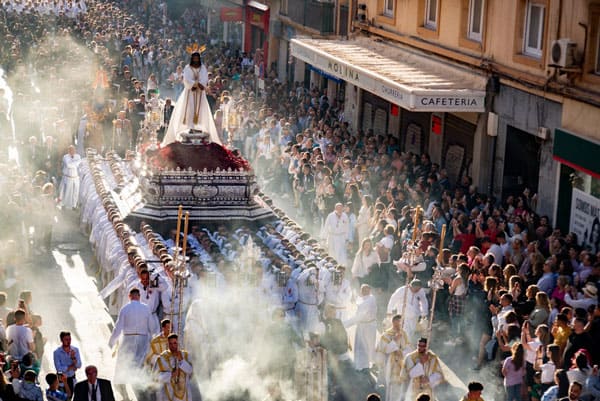
Ever wondered what makes an entire city shut down for a week? That’s the Holy Week in Malaga, one of the city’s biggest cultural and religious events for the annual commemoration of the Passion, Death, and Resurrection of Jesus Christ.
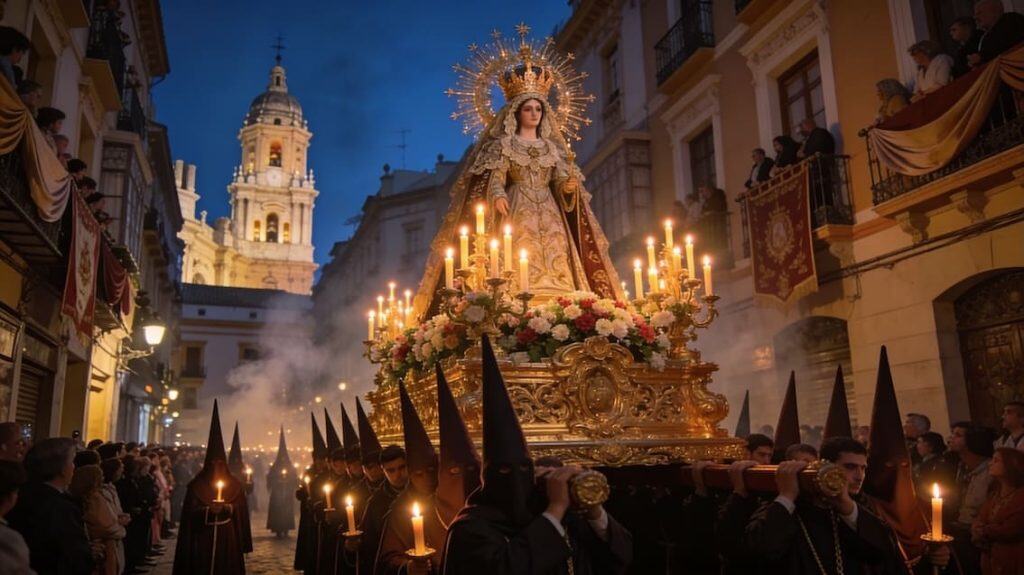
For seven intense days, 42 brotherhoods (cofradías) conduct 45 processions through the city streets, carrying jaw-dropping wooden sculptures of Christ or the Virgin Mary. Unlike other cities’ solemn and repetitive Holy Weeks, Malaga’s version pulses with energy, which is exactly why it was declared “Fiesta of International Tourist Interest” in 1965, drawing over five million visitors annually who come to witness this unique blend of sacred ritual and vibrant street theater.
Key Elements of the Holy Week in Malaga
So who’s actually pulling off this massive week-long event? Meet the brotherhoods! Think of them as historic volunteer clubs, often tied to a specific church or neighborhood, each with its own colors, history and mission. They are the ones who organize and carry the processions through Malaga.
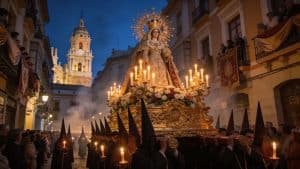
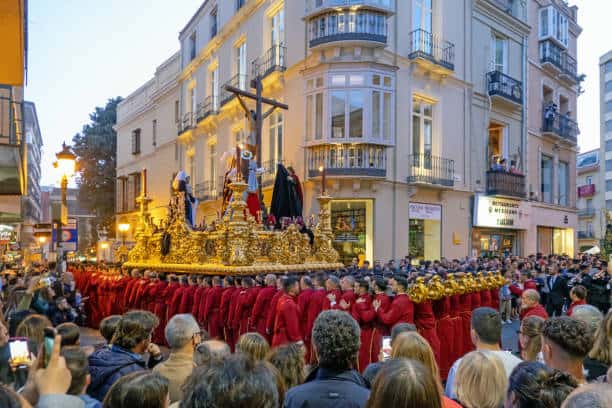
However, the real stars of the show are the thrones (tronos). These colossal rolling altars are way bigger than the ones you’ll see in other cities, and they carry priceless wooden sculptures, often centuries old, depicting scenes from Christ’s Passion or the Sorrow of the Virgin Mary.
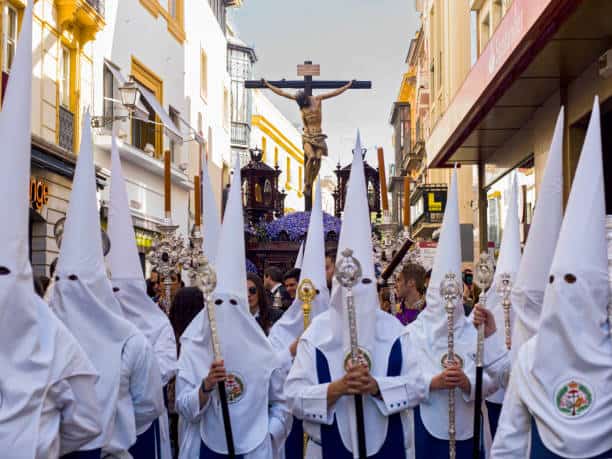
You’ll see two main groups in the processions. There are the hooded figures, or the Nazarenos (penitents). And, before you ask: no, the tall pointed hood (capirote) isn’t meant to be creepy. It’s about anonymity, letting them do their penance privately. Then there are the absolute powerhouses of the processions: the Hombres de Trono (Men of the Throne). These are the guys carrying the massive thrones on their shoulders for hours.
This massive group of people are coordinated by the Capataz (foreman), who calls the shots with a bell. The hombres de trono match their steps to the rhythm, so they can carry the massive statues in union. Keep your ears open for “Al cielo con ella!” (To the sky with her!): that’s when they lift the throne in unison, and trust me, it’s breathtaking.
Most processions have three marching bands, many formed by the brotherhoods themselves or even the military, playing marches written specifically to match the rhythm of the thrones. It’s this soundtrack that sets the pace, builds the mood, and turns the whole thing into a moving, emotional spectacle you won’t forget.

Navigating Semana Santa in Malaga: Routes, Processions and Traditions
Let’s take a deeper dive into how you can make the best of this crazy-busy week in Malaga. Trust me when I say: you need to study beforehand if you want to be able to properly enjoy the holy week!
1. When is Semana Santa in Malaga?
Semana Santa takes place in Malaga every year during the last week of Lent, immediately before Easter Sunday. It is arranged in a way that the last day of the procession is also Easter Sunday.
If you want to travel to Malaga to see the Semana Santa, keep in mind that you need to arrive before the week starts. Otherwise, there is a high chance you won’t be able to easily make it to your accommodation due to the crowd.
2. Where to watch the Semana Santa processions?
Here’s the deal: All 40-something processions start and end at their own churches, but they all share one common path called the ‘Official Route.‘
This route runs from the southern end of Plaza de la Constitución, through Calle Larios, Calle Martínez, Calle Atarazanas, and Calle Torregorda, then along Alameda Principal to Plaza de la Marina, before heading up Calle Molina Lario to the Cathedral entrance at Plaza del Obispo.
Here’s the map view for you to see the whole main route better:

3. How long do the processions last?
Are you planning to watch? Good. But, prepare yourself. Processions last many hours, and they move painfully slow.
There will be a massive crowd standing all day just to see the processions pass by. You can join them, but make sure you bring a bottle of water and some snacks with you because cafés and bars will also be super crowded!
If you are in it for the long haul, you might be interested in the seating areas that are placed on some points throughout the official route. You can book them through the Brotherhoods. But here’s the catch: tickets go on sale in early autumn and usually sell out fast. Any leftover seats pop up online shortly before Easter.
You can also try secondhand platforms like Milanuncios or Wallapop: just search “venta silla semana santa Malaga” and see what’s available. Fair warning though: it’s not gonna be cheap (tickets start around €83 for the whole week).
I would not be doing my job if I didn’t tell you where I go to watch the processions. If you head to ‘La Tribuna de los Pobres’, you will see a big stairway at the end of Calle Carretería where many people like me just take a free seat and enjoy the view. But, make sure to get there early (we’re talking at least two hours before) because frontline spots fill up fast.
4. Malaga Legionary procession
Semana Santa is big in Malaga, and the Legionary Procession is the star of the show. It is the procession to watch, if you are short on time or don’t want to waste too much energy into it.
On Maundy Thursday, the Spanish Legion disembarks dramatically at Malaga’s port to escort the venerated Cristo de la Buena Muerte (Christ of the Good Death) through the city streets. This tradition, which dates back to the 1920s, is all set to the sound of military music and the heartfelt singing of “El Novio de la Muerte” (The Boyfriend of Death).
Here is the exact route the Legionary procession takes:
On the morning of the Maundy Thursday at 10:00 AM, the troops dock at Malaga Port, landing at the Palmeral de las Sorpresas. From there, the parade makes its way through Plaza de la Marina, Calle Molina Lario, Plaza del Obispo, Plaza del Siglo, Plaza del Carbón, Calle Granada, Calle Calderería, Plaza de Uncibay, Calle Méndez Núñez, Calle Tejón y Rodríguez, Calle Carretería, Pasillo de Santa Isabel, Puente de la Esperanza, Calle San Jacinto, Plaza de La Legión Española and Plaza Fray Alonso de Santo Tomás.
Do expect massive crowds for this one! So if you want to be in the front, get there early, this is not the procession to show up at the last minute.
5. How to see Antonio Banderas in Malaga Semana Santa
If you didn’t know, Antonio Banderas is a proud Malagueño. And, like all true Malagueños, he cares deeply about Semana Santa. He visits every year to join the processions. Not to watch, but to participate in them.
There is a real chance you’ll spot Antonio Banderas in the crowd. Banderas is a member of the Lágrimas y Favores brotherhood, which means he will be dressing in the full nazareno tunic and capirote and carrying the procession with the rest of the brotherhood.
If you want to see him in action, you should attend the Virgen de Lágrimas y Favores procession on Palm Sunday. It usually sets off from San Juan Church at 3:20 PM, goes through Calle Larios, Alameda Principal, and Calle Molina Lario, before returning to San Juan Church at around 11:30 PM.

6. Lemons and salt: A refreshing Semana Santa ritual
Malaga doesn’t disappoint with its solution to the weariness caused by waiting on foot for hours. One of Malaga’s unique Semana Santa traditions is eating fresh lemon wedges sprinkled with salt, and trust me, it’s more refreshing than it sounds!
Street vendors pop up all along the procession routes selling them for less than €1. Locals call them “limones cascarudos” and they’re basically the Holy Week snack you didn’t know you needed.
Traslados in Malaga: A Calmer Semana Santa Experience
If you are not a fan of big crowds, there is still a way for you to be able to enjoy the famous Semana Santa in Malaga: Traslados.
Think of them as the underdog of Malaga’s Holy Week calendar. These are smaller, more intimate processions where the brotherhoods move their thrones and images from their church to the Brotherhood House, or the other way around.
They happen the week before or during Semana Santa. Make no mistake, they might be smaller, but there are a lot of them. While the numbers change every year, it is usually around 30 different processions.
Are Traslados are worth it?
Here’s the thing, most tourists don’t even know traslados exist and that’s exactly what makes them special. There will be no massive crowds, no official route crowds, no chaos.
Just you, the locals, and an incredibly raw and authentic experience of Semana Santa. The atmosphere is more relaxed, more personal, and the moment a throne moves through a narrow street with just a handful of people watching? That’s the kind of thing you’ll remember if you want to experience Semana Santa in Malaga, the way Malagueños actually live it.
Tips to Make the Most of the Semana Santa in Malaga
Don’t panic. There are ways to survive this week without losing your mind. Here are some of my tips to help you properly enjoy the Holy Week in Malaga:

1. Getting around Malaga during the Holy Week
First thing first, I highly suggest you leave your car at home, if you have one. Processions block roads constantly and many will even be closed throughout the week: driving into the centre is a nightmare you don’t need
If you really need to use your car, you can park for free by the Palacio de los Deportes on the west side of town and hop on the metro to Atarazanas station for easier access to the processions.
Keep in mind that the metro will run extended hours during the Semana Santa, lasting up until 2:00 AM.
2. Where to stay in Malaga during Semana Santa?
If you want to avoid the hustle of transportation altogether, and book your accommodation at the city centre, I have only one thing to say to you: hurry up.
Malaga attracts thousands and thousands of visitors during the Holy Week and hotels fill up fast, sometimes months in advance. The sooner you book, the better. If you can find one, try to book a street-facing room on Calle Molina Lario, Calle Larios, or Calle Granada and you’ll be able to enjoy the processions from the comfort of your room!
3. Processions cultural etiquette: Do’s and Don’ts
Joining the processions is an incredible experience, but it’s also a deeply meaningful religious event for locals. So before you attend, you need to know these unspoken rules.
Dress appropriately and respectfully. You can take photos and videos, just be mindful of the people behind you and avoid blocking their view. Also, keep your voice down when the throne passes. This is a moment of reverence, not a street party.
Don’t applaud unless it’s clearly appropriate and others around you are doing so. Avoid pushing or shoving your way through the crowd, or you might meet some reactions from locals.
4. Are the processions kid-friendly in Malaga?
Processions involve a lot of standing and waiting and let’s be honest, not every child has the patience for that. If you think your little ones can enjoy the atmosphere, please, keep a close eye on them at all times. The streets get incredibly packed and losing sight of a small one is easier than you’d think.
5. What happens if it rains during the processions in Semana Santa?
It is not unusual for Malaga to get lots of rain during the Semana Santa season. Therefore, the government is very proactive towards it.
If there’s a high chance of rain, processions may not happen or they might start and then be forced to turn back to their chapels mid-route. Cancellations can occur just hours before a procession is due to start, sometimes even at the last minute, it has happened before.
Not ideal, I know. To make sure you are on top of the schedules, just check the official app of the Semana Santa.
Things to do Beyond Processions in Malaga
Don’t get me wrong, Semana Santa is glorious in Malaga. But, there is a lot more this cute little Andalusian gem has to offer.
You can wander the small lively streets, climb up to the Alcazaba and then catch the sunset from the Mirador de Gibralfaro. Stroll past the Roman Theatre right at the foot of the Alcazaba and then head to the Cathedral.
Or, you can get a taste of local tapas with a local guide, or enjoy the nightlife with a group of tourists like yourselves!
My advice? Pick a few processions you really want to see, and spend the rest of your time exploring Malaga! Malaga is a whole experience. And once you’re here, you’ll wonder why you ever thought a few days would be enough.